Apollo pricing: plans, credits and what a team of three pays
Quick answer
Apollo pricing is per seat, and each seat comes with credits that pay for data. Free costs nothing and suits light use. Basic fits one rep doing regular outbound: contacting new people by email and phone. Professional adds unlimited sending, more mailboxes and more credits. Organization needs three seats and yearly billing. An email costs 1 credit and a phone number 8, and unused credits expire.
 By Tim Scheuer, Co-founder of Oxygen · Updated November 2, 2026
How much does Apollo cost per user?
Apollo's Basic plan costs $49 per seat a month billed yearly, or $65 billed monthly. Professional costs $79 a seat billed yearly, or $99 monthly. Organization costs $119 a seat a month, billed yearly only, with at least three seats. Free costs nothing, and all prices are before tax. Prices checked on Apollo's pricing page on November 2, 2026.
Every seat on an account is on the same plan, so you cannot put one rep on Professional and the rest on Basic. Each seat adds its credits to one pool the whole team shares. Basic and Professional come with a 14-day free trial. Organization does not. Apollo's pricing FAQ also lists a Custom plan, through its sales team, for custom volumes, single sign-on and dedicated support.
Sources: Apollo pricing, Apollo help: free trials
Apollo's plans at a glance
Apollo.io's prices per seat and what each plan adds, as its pricing page and plan table showed them on November 2, 2026.
| Plan | Billed monthly | Billed yearly | Credits per seat | What it adds |
|---|---|---|---|---|
| Free | $0 | $0 | 75 a month | 2 sequences (planned series of emails, calls and tasks), basic search filters, 250 email sends a day, 25 records per bulk action |
| Basic | $65 a seat a month | $49 a seat a month | 2,500 a month, or 30,000 a year up front | Unlimited sequences, waterfall enrichment (backup data providers), US dialer, 5 workflows (rules that run steps for you) |
| Professional | $99 a seat a month | $79 a seat a month | 4,000 a month, or 48,000 a year up front | A/Z tests of email versions, unlimited sends, unlimited Google and Microsoft mailboxes, unlimited lead scores (ratings of which leads fit best), 50 workflows |
| Organization | Yearly only | $119 a seat a month, 3 seats minimum | 72,000 a year up front | Single sign-on (one company login), sync for your own kinds of Salesforce records, custom permissions, 500 workflows |
What do you get on Apollo's Basic plan?
Each Basic seat gets 2,500 credits a month and unlimited sequences, for $49 a month billed yearly or $65 billed monthly. Apollo aims the plan at individual sellers doing regular outbound. Over Free, it adds advanced search filters and waterfall enrichment, and raises workflows from 2 to 5. You can also select 1,000 records from a search at once instead of 25.
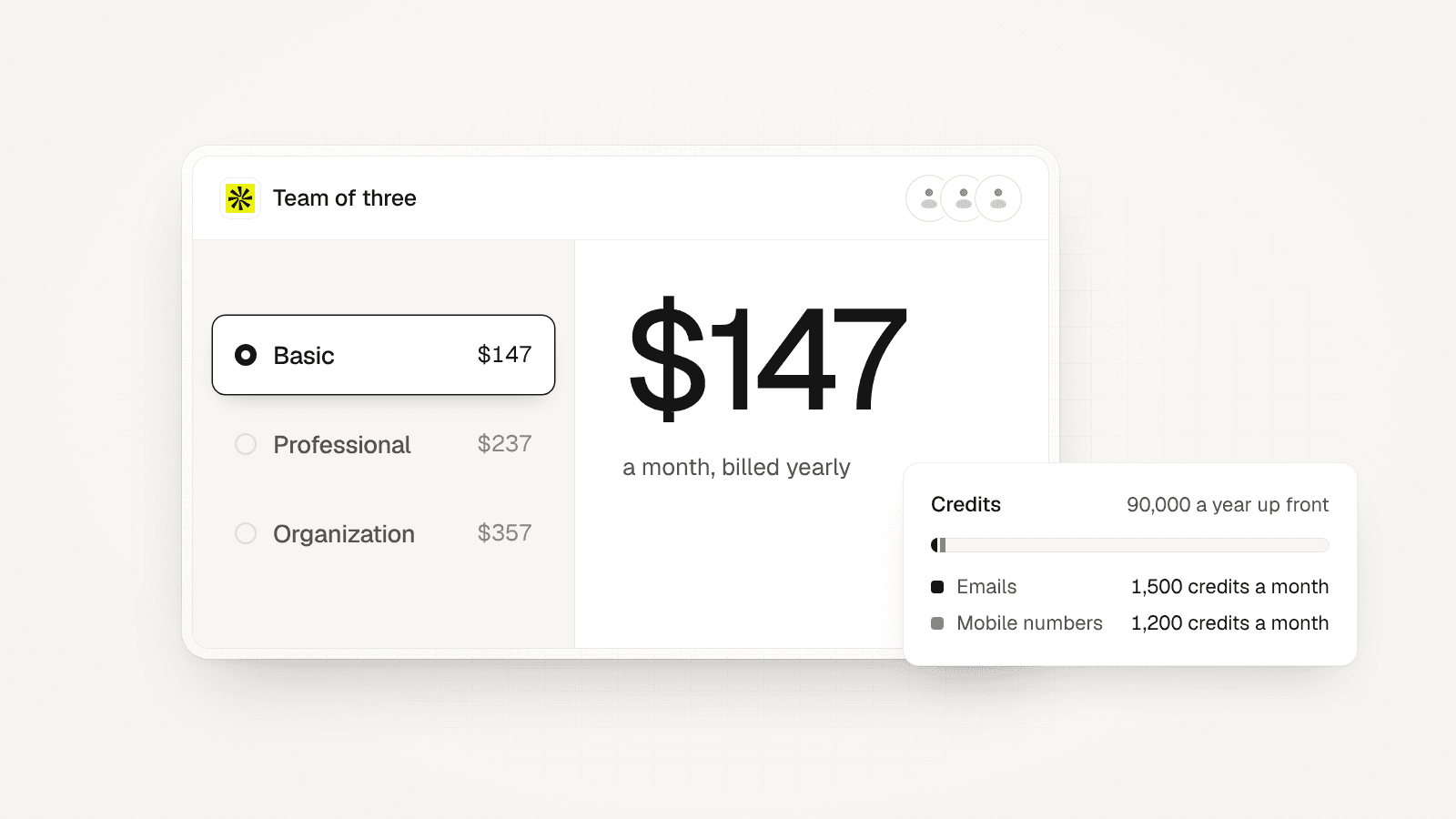
Basic is enough while each rep fits its sending limits: one mailbox and 250 emails a day. In the team of three below, credits are not the limit: the three reps use 2,700 of their 7,500 credits a month. When one rep needs more sends or a second mailbox, every seat moves to Professional, because an account has one plan. For three seats that means $237 a month billed yearly instead of $147.
- Not on Basic: A/Z tests of email versions, unlimited lead scores and call recording past 150 minutes.
Sources: Apollo pricing, Apollo plan comparison (JSON)
How do Apollo credits work?
Apollo credits are pooled across the whole team, and each kind of data costs a set number. An email costs 1 credit and a phone number 8. AI research costs 1 credit per run, and US calls 1 credit per 30 seconds. Enriching a record, which fills in its missing details, costs 1 to 8.

Credits arrive at the start of each billing cycle: every month on monthly billing, or the whole year's at once on yearly billing. Unused credits expire when the cycle ends, and that includes credits you bought on top.
- You pay for a verified email or any phone number for a new contact. The office phone number Apollo finds with an email is free.
- If a verified email bounces when you send to it from Apollo within 30 days, Apollo refunds the credit. Mobile numbers are never refunded.
- Waterfall enrichment asks other data providers when Apollo has no match. Each provider that returns data charges, and a lookup that finds nothing is free.
- Apollo's pages differ: its credit usage article says email and mobile data use separate balances, while its pricing page charges both from one pool.
- Calls use credits only when they connect, voicemail included: 30 seconds at least, then rounded up to the next 30 seconds.
- Extra credits cost 1.5 to 2.5 cents each. 1,000 more cost $25 a month, and they renew each cycle until you remove them.
Sources: Apollo pricing, Apollo help: credit usage, Apollo help: requesting contact data, Apollo help: waterfall enrichment
What are Apollo export credits?
Export credits pay for moving records out of Apollo, and its help center says they may apply only to some plans or older setups. Exporting contacts you have already saved to a CSV file uses no Apollo credits. Exporting new people straight from a search saves them first, and each one with a verified email uses 1 credit.
So the cost of an export is the cost of the new emails in it. Exporting 1,000 new people who all have verified emails uses 1,000 credits.
Sources: Apollo help: credit usage, Apollo help: exporting contacts to a CSV
What does Apollo cost a team of three?
A team of three pays $195 a month on Basic, or $147 a month billed yearly. On Professional the same team pays $297 a month, or $237 billed yearly. Organization starts at three seats and costs $357 a month, billed yearly only.

Take three reps who each reveal 500 work emails and 50 mobile numbers a month. That uses 2,700 credits, and three Basic seats get 7,500 a month, so it fits with room to spare. Phone numbers are what drain the pool: 300 a rep would use 7,200 credits on their own.
- Emails: 3 reps × 500 × 1 credit = 1,500 credits.
- Mobile numbers: 3 reps × 50 × 8 credits = 1,200 credits.
- Total: 2,700 of the 7,500 credits three Basic seats get each month.
- Billed yearly, the three seats cost $1,764 for the year and get 90,000 credits on day one.
- Running short? 5,000 extra credits cost $100 a month. Basic plus those credits costs $295, close to Professional's $297, which also lifts the sending limits.
Sources: Apollo pricing
Should you pay for Apollo monthly or yearly?
Pay yearly if you will use Apollo all year: a Basic seat drops from $65 to $49 a month, and Professional from $99 to $79. Choose the monthly subscription if you may stop sooner. Apollo's pricing FAQ says you can cancel anytime and keep the plan to the end of the paid month. Its terms say a plan renews unless you give written notice at least 30 days before its term ends.
Yearly billing is paid up front for 12 months. Moving to yearly is easy; moving back is not. You can switch from monthly to yearly at any time, and what you already paid counts toward the year. Going back to monthly means canceling and waiting for the year to end, and a yearly plan cannot be downgraded mid-cycle.
- A Basic seat gets 30,000 credits at the start instead of 2,500 each month, so a busy month can use more.
- Credits still expire when the billing cycle ends, so plan the year's use.
- Organization has no monthly option at all.
Sources: Apollo pricing, Apollo help: managing your plan, Apollo terms of service
Which Apollo limits push teams to upgrade?
Basic's tightest limits are on sending: one mailbox per user and 250 email sends a day. Professional lifts both, with unlimited sends and unlimited Google and Microsoft mailboxes. The other limits cover automation, search and bulk actions.

- Free: 2 sequences per team and 25 records per bulk action.
- Basic: 5 workflows, 1,000 records per bulk action and no A/Z tests of email versions.
- Professional: 50 workflows, 2,500 records per bulk action and call recording up to 4,000 minutes.
- Organization: single sign-on, sync for your own kinds of Salesforce records and 500 workflows, from three seats on yearly billing.
- Search: Apollo shows up to 100 pages of results. The record limits above cover new people from a search; saved contacts can be selected 50,000 at once.
Sources: Apollo pricing, Apollo plan comparison (JSON), Apollo help: troubleshooting search filters
Which Apollo costs are easy to miss?
Phone numbers, mailboxes bought in Apollo and extra credits that renew each cycle are the costs that are easy to miss. All of them draw on credits or renew without a new purchase.
- Phone numbers: 8 credits each, so 100 numbers use as many credits as 800 emails.
- Mailboxes: a Google Workspace mailbox bought in Apollo costs 800 credits a month, and a domain 1,500 credits a year.
- Extra credits renew on their own each cycle until you set them back to zero.
- On monthly billing, a plan downgrade brings no refund for the rest of the cycle.
- Validators, optional tools that check each email or number found, charge for every check, not once per run.
Sources: Apollo pricing, Apollo help: managing your plan, Apollo help: waterfall enrichment, Apollo help: domains and mailboxes
When is Apollo worth the price?
Apollo is worth it when you want a large contact database and email outreach in one tool. It lists 240 million contacts and 30 million companies, plus sequences, a dialer and CRM sync. CRM sync keeps a customer database such as HubSpot up to date.
It fits less well when phone numbers or LinkedIn drive your outreach. Numbers cost 8 credits each, and LinkedIn steps in an Apollo sequence are reminders: a rep still sends each invite and message by hand.
- Good fit: email-first outbound for a small team that needs contacts as well as a place to send.
- Good fit: teams on HubSpot or Salesforce that want new emails and phone numbers synced to the CRM.
- Think twice: finding new customers mainly by phone, where 8 credits a number adds up fast.
- Think twice: a team where one person needs Professional, since every seat then pays for it.
Sources: Apollo pricing, Apollo help: waterfall enrichment, Apollo help: LinkedIn tasks in a sequence
How can you pay less for Apollo?
The biggest saving is yearly billing: about a quarter off Basic and a fifth off Professional. After that, savings come from watching what draws on credits.
- Set a credit cap per user, so one rep cannot drain the shared pool.
- Keep the waterfall to Apollo's own data when its coverage is good enough, so other providers do not charge.
- Export contacts you have already saved, which uses no credits.
- Remove extra credits before the renewal date once a busy month is over.
- Send to new emails from Apollo, so a bounce within 30 days earns the credit back.
Sources: Apollo pricing, Apollo help: requesting contact data, Apollo help: exporting contacts to a CSV, Apollo help: managing your plan, Apollo help: waterfall enrichment
Is Apollo cheaper than ZoomInfo?
Apollo publishes its prices and ZoomInfo does not, so only Apollo's can be checked before a sales call. ZoomInfo's pricing page lists its Professional, Copilot Advanced and Copilot Enterprise packages and asks you to fill in a form for pricing.
Both offer free trials, and Apollo also has a free plan. A fair test is a trial of each, with a written ZoomInfo quote for your team size next to Apollo's seat price.
Sources: Apollo pricing, Apollo help: free trials, ZoomInfo pricing
What does a team of three pay on OXYGEN?
The same team's data costs about $311 a month on OXYGEN: the $199 plan plus 8,600 credits in top-ups. That buys 1,500 work emails found and checked and 150 mobile numbers found. Each email found costs about $0.085, and each number about $0.99.
So for this job Apollo is cheaper: three Basic seats cover it for $195 a month. OXYGEN has no contact database of its own. It tries up to 17 email and 13 phone providers in turn, on plan credits or your own keys. Your own keys, the codes that link your accounts with those providers, work from the $99 plan.
Where OXYGEN fits is the work after the data. It charges per workspace, your team's shared account, not per seat. LinkedIn steps run in the same sequence as email, at $34 a month per connected account and with no browser extension. Inboxes bought in OXYGEN cost $4 a month with warm-up included, on a sending domain at $12.50 a year. Warm-up sends a slowly rising number of emails so a new inbox earns trust.
If you connect your Apollo key, keep the contacts it finds out of automated LinkedIn steps: Apollo's terms bar "using any API with LinkedIn automations". The terms also forbid sharing a seat, so each person who uses Apollo data needs their own Apollo seat.
- Seats: no charge; the CRM, tables and extra users are free.
- Work email found: about $0.085, and a check of it about $0.00225.
- Second check, where a domain accepts all mail: $0.017, assumed for 20% of addresses.
- Phone number found: about $0.99, nothing on a miss.
- A free workspace comes with 250 credits once, to test lookups first; LinkedIn accounts and inboxes need a paid plan.
Sources: Apollo pricing, Apollo terms of service
What OXYGEN does not do here
- No contact database of its own: searches run through data providers on credits.
- Emails and phone numbers cost more per contact than Apollo's credits: about $0.085 and $0.99 per value found.
- Calling is in beta: you turn it on in settings, then call from a softphone, a phone built into OXYGEN's web app.
- No Salesforce sync; HubSpot syncs both ways.
- Connecting your own provider keys needs the $99 plan or above. Each successful call on one adds an OXYGEN platform fee, even when it finds nothing.
Frequently asked questions
Is Apollo free?
Yes. Apollo's Free plan costs nothing and has no time limit. It includes 75 credits a month, two sequences and basic search filters. You can also try Basic or Professional free for 14 days, once per account.
How much do Apollo credits cost?
Extra Apollo credits cost 1.5 to 2.5 cents each, and the price per credit drops as you buy more. Plan credits come with each seat: 2,500 a month on Basic and 4,000 on Professional. An email uses 1 credit and a phone number 8, so a phone number paid with extra credits costs 12 to 20 cents.
How many credits does a phone number cost on Apollo?
Eight. Apollo's pricing page lists a phone number at 8 credits and an email at 1. Phone numbers use up a credit pool eight times faster. Apollo does not refund credits for mobile numbers, and a free trial caps phone numbers at 20.
Do Apollo credits roll over?
No, Apollo credits do not roll over: unused credits expire at the end of each billing cycle, including extra credits you bought. Paid plans on yearly billing get the whole year's credits at the start, which gives a busy month more room. Monthly plans start each month with a fresh balance.
What is an Apollo export credit?
Export credits pay for moving records out of Apollo, and Apollo's help center says they may apply only to some plans or older setups. Exporting contacts you have already saved to a CSV file uses no credits. Exporting new people from a search saves them first, at 1 credit for each one with a verified email.
Can a team mix Apollo plans?
No. Every seat on an Apollo account is on the same plan, so you cannot put one rep on Professional and the rest on Basic. Apollo's advice is to pick the plan your heaviest users need. Credits are pooled, so credits a light user leaves are there for the rest of the team.
Does Apollo have a free trial?
Yes. Basic and Professional come with a 14-day free trial, once per account, and Organization has none. A trial caps bulk actions at 25 records, phone numbers at 20 and calls at 60 minutes. Upgrading during the trial ends it, and unused trial credits do not carry over.
Does Apollo have a search limit?
Yes: Apollo shows up to 100 pages of results per search, and each plan caps how many new records you can select at once. The cap is 25 records on Free, 1,000 on Basic, 2,500 on Professional and 10,000 on Organization. If a search reaches 100 pages, Apollo suggests adding filters to narrow it.
Related
Linked from
Sources
- Apollo pricing, checked November 2, 2026
- Apollo plan comparison (JSON), checked November 2, 2026
- Apollo help: credit usage, checked November 2, 2026
- Apollo help: requesting contact data, checked November 2, 2026
- Apollo help: exporting contacts to a CSV, checked November 2, 2026
- Apollo help: managing your plan, checked November 2, 2026
- Apollo help: free trials, checked November 2, 2026
- Apollo help: waterfall enrichment, checked November 2, 2026
- Apollo help: domains and mailboxes, checked November 2, 2026
- Apollo help: LinkedIn tasks in a sequence, checked November 2, 2026
- Apollo help: troubleshooting search filters, checked November 2, 2026
- Apollo terms of service, checked November 2, 2026
- ZoomInfo pricing, checked November 2, 2026
Updated November 2, 2026. OXYGEN's own prices and limits come from the product and its live price list. The other products named here are trademarks of their owners and are not affiliated with OXYGEN. Something out of date? Tell us.